Chicken
The Best Easy Roast Chicken
Tender, delicious, and full of flavor – the best easy roast chicken recipe every home cook should have on hand – a moist, juicy masterpiece!
- Serves 6
- Prep 10 minutes
- Cook 1 hour
- Total 1 hour
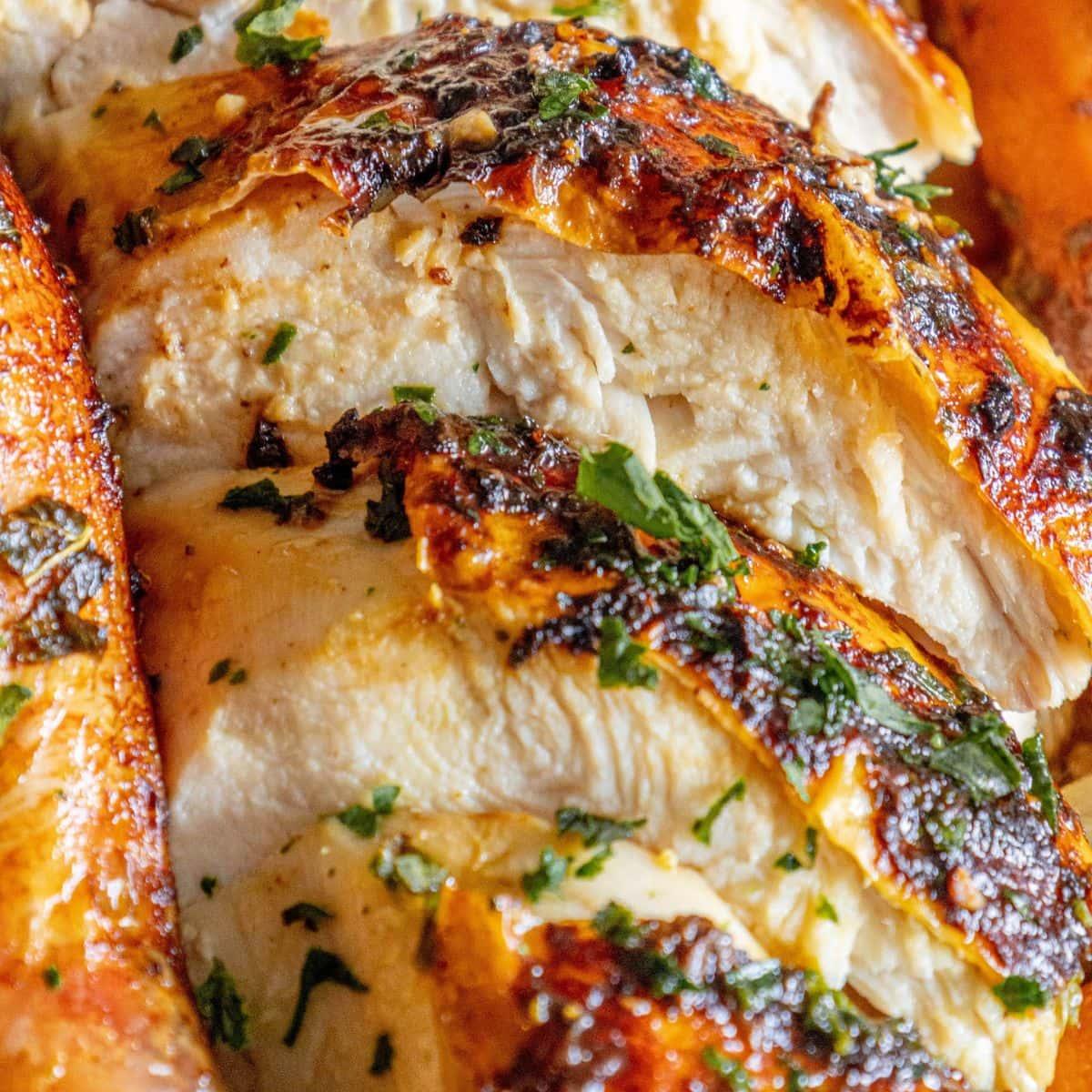
Delicious, juicy roasted whole chicken with crispy skin and perfectly tender meat, loaded with garlic, butter, and herbs – this is one simple home-cooked meal that everyone loves, and is full of comforting flavor! I’ve been making this Classic Roast Chicken Recipe since I was in college – it is simple, straightforward, and easy to get right, every single time you make it.


At Ajpal, I add lots of tips in all of my recipes – because I am a home cook without any formal training, and I find I am more confident making dishes when I understand why it works, and what each ingredient means to the flavor of a recipe. My goal is for even the most beginner home cook to feel empowered in the kitchen.
How to Roast a Whole Chicken
Whole roast chicken is a delicious, simple, and low carb dinner that everyone loves – and goes with just about any side dish. It’s also perfect for a dinner party where you will be making other main dishes like pork tenderloin or ribeye roast, with a down-home classic flavor everyone knows and loves. It’s great on it’s own, or with some Carrot Top Chimichurri or Roasted Tomato Marinara Saucespooned over the top.
Whole Roast Chicken Ingredients
To roast a whole chicken, you will need the following ingredients:
- Whole Chicken – When looking for a whole roasting chicken, you’re looking for a “broiler” or a “young fryer.” These terms are refer to chickens raise specifically for eating, rather than for their eggs. I used a young fryer for this recipe, as they’re smaller and often more tender. A young fryer is typically around 4-4.5 pounds.
- Butter – Butter literally makes everything better. I used butter in this recipe to add extra flavor and to help keep the chicken breasts moist. Additionally, the butter solids brown to a beautiful chestnut hue on the chicken skin and makes it deliciously crisp.
- Italian Seasoning herb blend – This blend of oregano, basil, thyme, rosemary, and marjoram is a staple of Italian cooking and flavors that complement chicken and beans well.
- Salt and Pepper – Every savory dish is accented, and improved by, fine salt and freshly cracked black pepper. I used French sea salt in this recpie, but any high quality salt will do.
- Lemon – Lemon brings acid and a bright, fresh flavor to the rich butter and chicken flavoring. Tangy flavor greatly enhances the flavor of the chicken, and the acid helps to keep it tender and moist.
- Garlic – Garlic brings aromatic and earthy flavors to this chicken. Roasting the chicken with the garlic helps infuse more flavor into the roasting bird.
- Onion – Similar to the garlic, onion brings hearty sweet flavor to the to roasting process, and aromatics that flavor the chicken as it roasts.
- Carrots – The carrots in the roasting pan bring a sweet and savory flavors to the roasting pan. As the chicken cooks it will baste the carrots and onions in the pan with rendered fat and cooking jucies and creates a delicious sauce over the carrots.
Process to Roast a Whole Chicken
Once you’ve gathered your ingredients, you will use the following method:

Clean Chicken
Remove your chicken from the packaging you can also wash thoroughly with cold water. Remove the giblets from your chicken’s cavity. Trim and excess fat and pat the chicken dry with paper towels.

Prep & Season
Place one quartered onion, half the garlic, and the lemon slices in the cavity of the chicken. Take your softened butter and combine with the Italian Herb Seasoning, then rub the mixture liberally under the skin of the chicken on the breasts. Liberally season the outside of the chicken with salt and pepper. Truss chicken with bakers twine (tie legs together), if desired.

Roast Chicken
In a roasting pan, add the remaining garlic and onions and the chopped carrots, seasoning with salt and pepper. Place the seasoned chicken on top of the vegetables in the roasting pan and place in a 400oF oven. Roast for and hour and a half, or until the chicken reaches an internal temperature of 165oF and the skin is crispy and golden brown.

Rest
When your chicken is golden brown and has reached an internal temperature of 165oF. Remove the vegetables and the chicken to a platter and lightly tent with foil. All the chicken to rest for 20-30 minutes before slicing.

Slice & Serve
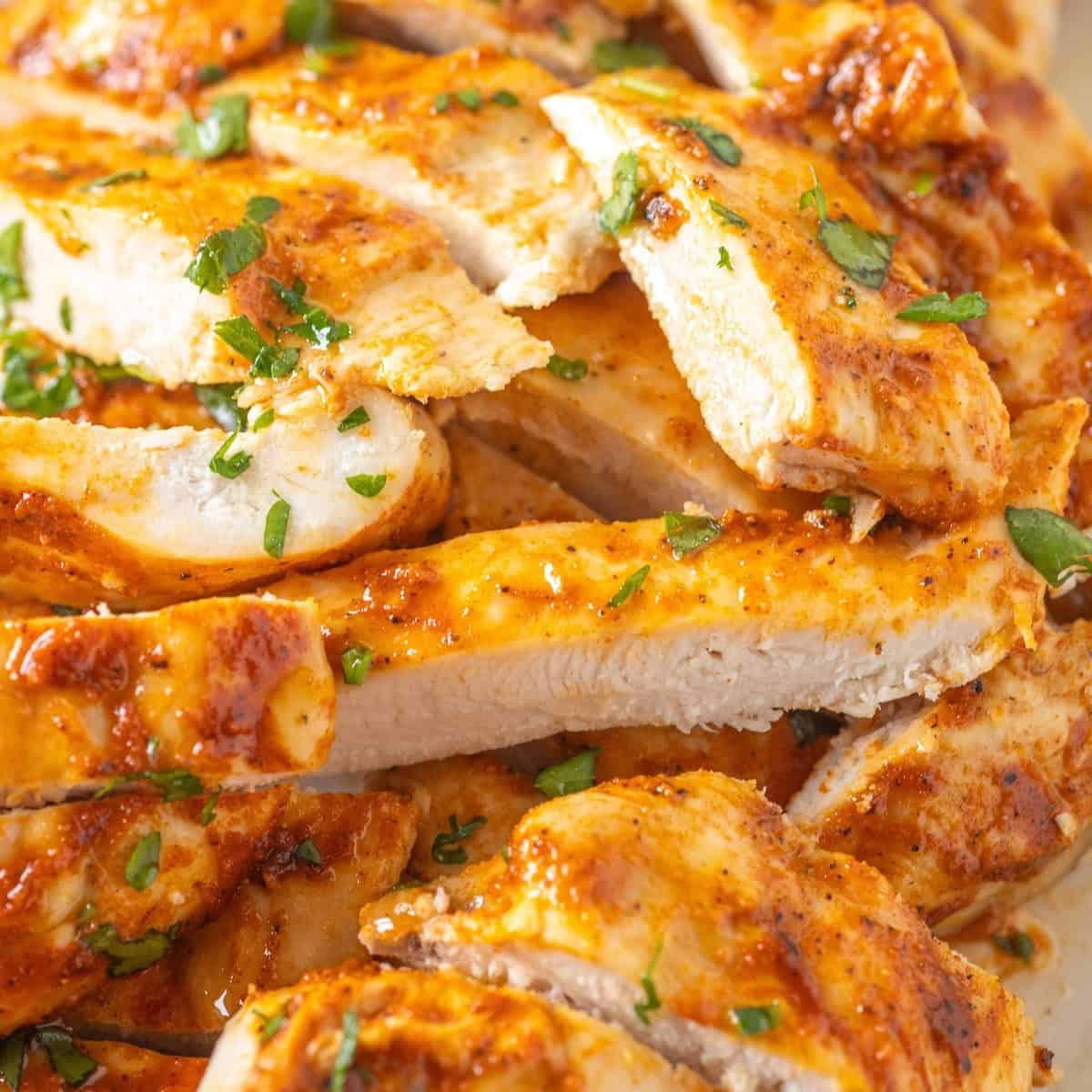
To cut a whole roast chicken, start by removing the legs and thighs by slicing through the joints, then separate the wings and carve the breasts off the bone in long, even strokes. Use a sharp knife and steady cutting board, and let the chicken rest before carving to keep it juicy.
Tips and Tricks to Perfect Roast Chicken
If you’ve had bland chickens in the past, we’re going to try to help combat that!
Use a Flavor Injector for Roast Chicken. There are a lot of ways to improve the flavor of your chicken – using a flavor injector (click here for my favorite flavor injector) to add marinades, melted butter, or juice (orange juice is perfect.)
Pick the Right Chicken. Selecting a heritage breed chicken look for smaller birds, organic chickens, or reach out to a local farmer near you for a better tasting bird!.
Brine before roasting. Brining poultry always adds more flavor and helps to keep chicken from drying out when roasting. To brine the chicken, use a brine like you would a turkey, for up to one day before cooking. Be sure to pat dry before adding butter.
Season well. Add lots of herbs and spices to your chicken – more than you’d think, as you’re counting on the flavor to largely infuse through the chicken skin, unless you’re injecting flavor into your chicken.
Inject. Use a flavor injector to inject melted butter with herbs and spices to keep your chicken extra moist, juicy, and bursting with flavor. Click here for my favorite flavor injector.
Baste. As your chicken cooks, it is optional (but in my mind, important), to baste your chicken for even more flavor. Basting pulls up the rendered fat from your chicken, as well as the melted butter, herbs, and liquid from the onions, carrots, lemon, and garlic in your pan, and coats your chicken in them – making sure you get even more of that amazing flavor in every bite. Basting also helps give your chicken a beautiful, rich amber color and shiny glow.
Opt for organic or local farmers. Pick chicken that is organic, without antibiotics and saline injected before sale for the freshest, most delicious and flavorful chicken. We often opt for smaller birds from local farms nearby instead of large factory-bred chickens when possible for a more intense flavor. If you think chicken all has a bland flavor, you might need to find a different source for your chicken!
Butter under chicken skin. Always lift up chicken skin and generously butter under it for the most delicious crispy chicken skin that is crunchy and crackles! This step only takes a few moments and makes a huge impact to your chicken’s flavor.
Check for giblets. Always check the chickens cavity for the giblet packet and remove before roasting, as it is almost always packed in plastic.
Stuff the cavity. While the chicken’s cavity is not edible, it does provide a great way to add extra flavor by loading it up with aromatics – stuff with sliced lemons, onions, garlic, fresh herbs, and let them infuse your chicken with even more flavor as it cooks.
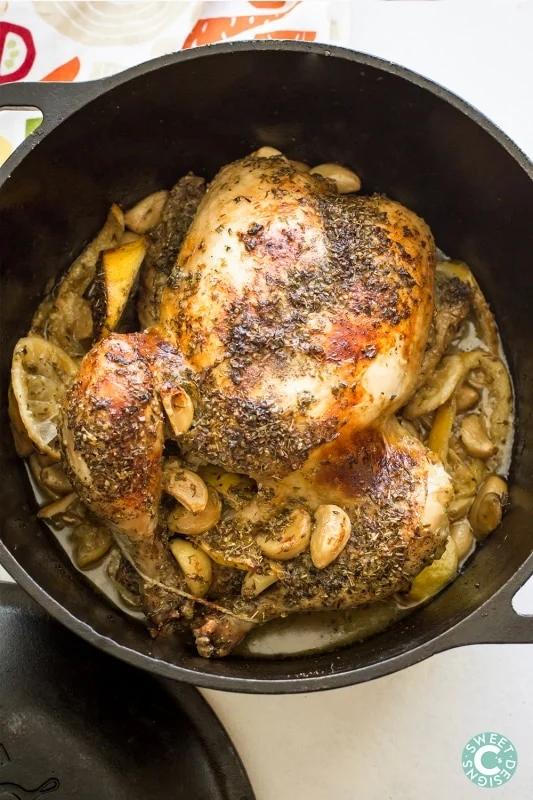
Try different herbs. This recipe is meant to be a jumping off point – you can customize it all you want! Try our Easy Whole Roasted Montreal Chicken and Dutch Oven Grecian Chicken for different takes on this knockout recipe.


Roast Chicken FAQs
Trussing a chicken means making sure the chicken’s legs and wings are secured to the chicken as it cooks, usually meaning tying the chicken’s legs together during cooking to keep the chicken’s shape while cooking and to keep it compact.
While trussing a chicken does help to keep the chicken compact during cooking, which can help promote even cooking and a better appearance, this is considered an optional step and isn’t strictly necessary. If you don’t have baker’s twine, or another way to tie the chickens legs together, don’t worry about it.
If you’re out of bakers twine and desperate to truss your chicken, don’t use any old string (did Bridget Jones’ blue soup teach us nothing?) – only food-safe items should be used when cooking. Instead, grab a long branch of rosemary or thyme and loop it around the chicken legs, making a figure 8, then tuck the ends into themselves to secure.
Using a rapid-read digital meat thermometer (I love the thermoworks thermometers), probe the thickest part of both the chicken’s breast and thigh. When both have reached 160 degrees Fahrenheit, the chicken can be removed from the oven to carryover cook the final 5 degrees to 165F.
Chicken is safe to eat at 165 degrees F.
Chicken will carryover cook 5 degrees after removal from the oven, so you want to get your chicken to 160 degrees in the oven, and then let it rest for at least 20 minutes before carving to fully cook.
Roast chicken should be cooked at 400 degrees F. Roast chicken should be cooked quickly so the meat doesn’t dry out and the skin crisps up beautifully, so we will use a higher heat.
If your chicken skin is getting very brown, but the meat is not done cooking, cover it with foil.
Basting chicken adds more flavor, color, and shine to your chicken – giving it a knockout appearance and irresistible taste.
What to Serve With Roast Chicken
Roast chicken is a great dish that goes with just about anything – it is the perfect meal for so many beautiful side dishes!
We love serving roast chicken with a Red Pepper Zucchini Farro Salad, our deliciously impressive Pesto Stuffed Burrata, some simple Garlic Butter Roasted Potatoes that can share the oven alongside your chicken – or a German Potato Salad!
For more of our favorite side dishes, check out our recent favorites:
Roasted Asparagus in Oven
Honey Garlic Roasted Carrots
Crispy Roasted Potatoes
Easy Roasted Tomatoes Recipe
Share on Facebook
Pin this now to find it later


The recipe
The Best Easy Roast Chicken
Delicious moist roast chicken is covered in herb infused butter on a delicious bed of roast vegetables.
- Serves 6
- Prep 10 minutes
- Cook 1 hour
- Total 1 hour
Ingredients
- 1 roaster chicken
- ½ cup butter (softened)
- 2 tablespoons Italian Seasoning herb blend
- Salt and Pepper (to taste)
- 2 tablespoons lemon juice
- 1 lemon (sliced)
- 1 head garlic
- 1 onion
- 3 carrots
Method
- 1
Preheat oven to 400 degrees.
- 2
Remove your chicken from the packaging and wash thoroughly with cold water.
- 3
Optional: brine chicken at this point for a day ahead of time for the best flavor.
- 4
Remove the giblets from your chicken. Trim and excess fat and pat the chicken dry with paper towels.
- 5
Place one quartered onion, half the garlic, and the lemon slices in the cavity of the chicken.
- 6
Take softened butter and combine with the Italian Herb Seasoning, then rub the mixture liberally under the skin of the chicken on the breasts.
- 7
Liberally season the outside of the chicken with salt and pepper. Truss chicken with bakers twine (tie legs together), if desired.
- 8
In a roasting pan, add the remaining garlic and onions and the chopped carrots, seasoning with salt and pepper.
- 9
Place the seasoned chicken on top of the vegetables in the roasting pan and place in a 400oF oven.
- 10
Roast for and hour and a half, or until the chicken reaches an internal temperature of 165oF and the skin is crispy and golden brown. Baste frequently as it cooks (optional, for more flavor and golden skin) if desired.
Notes
If chicken skin is getting too brown in one spot, you can cover that part with foil. Skin will look dark brown – that does not indicate burning unless it is black and smells acrid – it is just a dark caramel color!
Equipment
- Zulay Premium Quality Metal Lemon Squeezer, Citrus Juicer, Manual Press for Extracting The Most Juice Possible
- All-Clad E7649764 HA1 Hard Anodized Nonstick Roaster Cookware, 13-Inch by 16-Inch, Black
Nutrition
- Serving1 g
- Calories171 kcal
- Carbohydrates1 g
- Protein4 g
- Fat17 g
- Saturated Fat10 g
- Polyunsaturated Fat6 g
- Trans Fat1 g
- Cholesterol54 mg
- Sodium183 mg
- Fiber1 g
Questions
What is trussing a chicken?
Trussing a chicken means making sure the chicken’s legs and wings are secured to the chicken as it cooks, usually meaning tying the chicken’s legs together during cooking to keep the chicken’s shape while cooking and to keep it compact.
Do I have to truss the chicken?
While trussing a chicken does help to keep the chicken compact during cooking, which can help promote even cooking and a better appearance, this is considered an optional step and isn’t strictly necessary. If you don’t have baker’s twine, or another way to tie the chickens legs together, don’t worry about it.
I don’t have bakers twine – what can I use to truss a chicken?
If you’re out of bakers twine and desperate to truss your chicken, don’t use any old string (did Bridget Jones’ blue soup teach us nothing?) – only food-safe items should be used when cooking. Instead, grab a long branch of rosemary or thyme and loop it around the chicken legs, making a figure 8, then tuck the ends into themselves to secure.
When is a whole roasted chicken done?
Using a rapid-read digital meat thermometer (I love the thermoworks thermometers), probe the thickest part of both the chicken’s breast and thigh. When both have reached 160 degrees Fahrenheit, the chicken can be removed from the oven to carryover cook the final 5 degrees to 165F.
What temperature should I cook roast chicken to?
Chicken is safe to eat at 165 degrees F. Chicken will carryover cook 5 degrees after removal from the oven, so you want to get your chicken to 160 degrees in the oven, and then let it rest for at least 20 minutes before carving to fully cook.
What temperature do I roast chicken at?
Roast chicken should be cooked at 400 degrees F. Roast chicken should be cooked quickly so the meat doesn’t dry out and the skin crisps up beautifully, so we will use a higher heat.
My chicken skin is getting really dark, should I cover it?
If your chicken skin is getting very brown, but the meat is not done cooking, cover it with foil.
Should I baste roast chicken?
Basting chicken adds more flavor, color, and shine to your chicken – giving it a knockout appearance and irresistible taste.